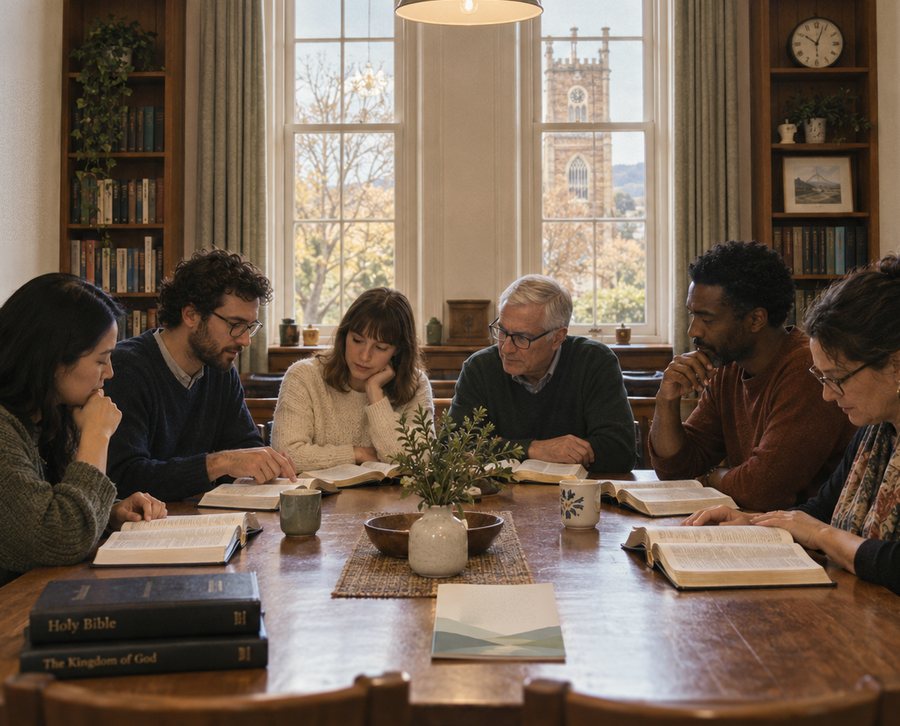
God's Master Plan
Introduction
What the course covers, how it is put together, and why the plan is worth eight lessons of anybody's time.
Objective
What this course is for
This course is intended as an introduction to the good news of God's Master Plan. The course explores the faith and obedience that God requires from those wanting to share in God's wonderful plan for the earth.

Bible references throughout this course are from the New International Version unless otherwise stated.
Scripture taken from the Holy Bible, NEW INTERNATIONAL VERSION®, NIV® Copyright © 1973, 1978, 1984, 2011 by Biblica, Inc.® Used by permission. All rights reserved worldwide.

Part 1 of 3
Two areas
The course covers two things, and it is worth knowing which is which before you start. Six lessons on what the plan is, then two on what it asks of you.
Overview
Two important areas
God's Master Plan is the central theme of the Bible. Our investigation into this plan will cover two important areas.
The first area (lessons 1-6) deals with the fundamental concepts of this plan. The Bible often refers to these fundamental concepts as the good news or the gospel.
The second area (lessons 7-8) focuses on the practical obedience required of those wanting to share in God's Master Plan. Understanding the Master Plan is really a learning process. The final two lessons of this course (7 and 8) look at how this learning must be applied in practical living through obedience to the gospel.
Paul tells us in his second letter to the Corinthians that we need to ensure that our understanding of the gospel is accompanied by obedience.
“Because of the service by which you have proved yourselves, men will praise God for the obedience that accompanies your confession of the gospel of Christ....”
2 Corinthians 9v13
(a) The Gospel
What the gospel is
The gospel is the good news about the kingdom of God and the name of Jesus Christ. This good news is preached throughout the whole Bible. For example we find Philip preaching the gospel to the people he met:
“But when they believed Philip as he preached the good news of the kingdom of God and the name of Jesus Christ, they were baptised, both men and women.”
Acts 8v12
The gospel preached in the early days of Christianity consisted of the kingdom of God and the name of Jesus Christ.
(b) Obedience
And then what it asks
Lesson 7 covers the important steps required of those who wish to participate in God's Master Plan.
Lesson 8 provides a brief overview of the behaviour expected of those who have chosen to participate in God's Master Plan.


Part 2 of 3
The shape of the course
The following is a diagrammatic structure of this course. Open each of the three groups to see which lessons sit where, and why.
The whole course
A diagrammatic structure of this course
Salvation is the faith God requires for eternal life in His Kingdom. It has two parts, and the eight lessons divide between them.
Open all three groups.
(A) Kingdom of God
Belief in the gospel begins here. What the plan is, how God will bring it about, why it is needed, and what stands in the way.
Lessons 1, 2, 3 and 4 focus on issues relating to the kingdom of God.
(B) Name of Jesus Christ
The other half of what the early church preached. Who the promised seed turned out to be, and who the Planner is.
Lessons 5 and 6 focus on the name of Jesus Christ.
(C) Obedience
A life of obedience, which is the second part of what God requires.
Lesson 7 covers the important steps required of those who wish to participate in God's Master Plan. Lesson 8 provides a brief overview of the behaviour expected of those who have chosen to participate in God's Master Plan.
Notes: All references quoted are from the New International Version (NIV) of the Bible, unless otherwise indicated.

Part 3 of 3
Preface
Why the course was written, and what the people who wrote it hope you will do with it.
Preface
Why this course exists
God's Master Plan is the central theme of the Bible. Understanding clearly God's plan and purpose with the earth gives meaning and context to so many parts of the Bible.
This course has arisen out of a desire to set out in a simple manner the essential elements of God's Plan. Understanding God's Master Plan should form the basis of the faith of any follower of the God of the Bible.
The course can be used as an aid or as an introduction to those seeking to understand God's plans for the future. This course is best read with a Bible in hand. To maintain clarity and volume many supporting Bible references have not been quoted in full. Readers are encouraged to turn up all Bible references.
Work through it like this
- Keep a Bible beside you and turn up every reference as you reach it
- Take the questions as they come, and read the answer either way
- Stop whenever you like, and the course remembers where you were
Preface
What we hope it does
We have attempted to write the course in a straightforward and easy to read style. The essence of God's Master Plan is simple and easy to understand although there are so many aspects relating to this topic. The challenge has not been on what to include but rather on what to leave out.
We hope that you will find the course easy to read and interesting.
Most of all we hope that it will stimulate you to read more actively and carefully the most important reference book on God's Master Plan, the Bible.

Have a question?
Ask your tutor
You have finished the introduction
That is the shape of it. Eight lessons, starting with the plan itself.
Introduction complete
Lesson 1
What is God's Master Plan? Why the earth was formed, what the glory of the LORD means, and where people come into it.
Go to lesson 1