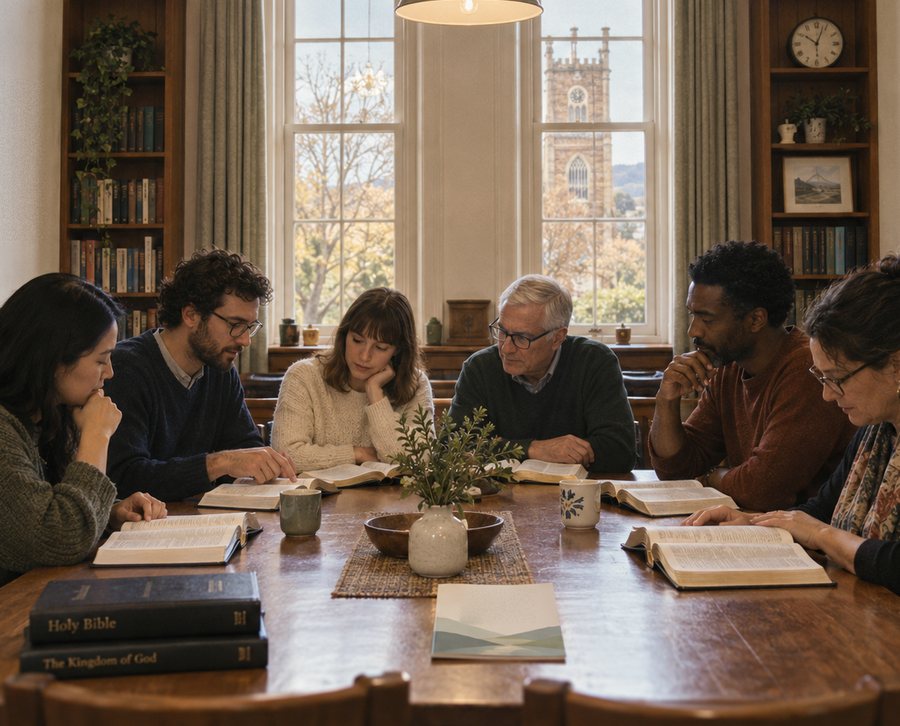
Introduction to Bible Basics
Lesson 1
The Bible
A twelve-part course in the foundations of Bible teaching.
The Bible makes an enormous claim
The Bible makes great claims. It clearly states that its author is God - the Creator of the universe. It claims to reveal God and His purpose and it speaks with authority.
The Bible, as the true Word of God, contains the key to peace and happiness. It answers the most perplexing questions concerning the meaning and purpose of our existence and the final outcome of the struggle between right and wrong.

Lesson 1
By the end of this lesson
You will be able to:
- Describe what the Bible claims about its own origin, and name the two passages that make that claim
- Identify how the Bible is put together: two testaments, 66 books, and the four sections within each testament
- Explain four lines of evidence that support the Bible's claim to be inspired
- Apply the four conditions and the five-step method to your own Bible reading
How to work through this course
We suggest that you follow this method:
Step one
Read the study carefully
Step two
Look up each Bible reference as you come to it
You will need to have a Bible available whilst you work through these studies. This course is incomplete without reference to the Bible itself.
Step three
Re-read the study
Step four
Read again each Bible passage suggested as reading
Step five
Answer the questions

Part 1 of 6
The claim
The Bible does not hint that it came from God. It states it plainly, in two places, and both writers say the same thing.
The claim
What the writers said

Paul, writing of the Old Testament, says,
“All Scripture is given by inspiration of God”
2 Timothy 3 v 16
Every word of the original manuscripts was written under direct Divine guidance. The Apostle Peter stressed the same fact,
“For the prophecy came not in old time by the will of man: but holy men of God spake as they were moved by the Holy Ghost”
2 Peter 1 v 21 · Holy Spirit in the Revised Version
These two apostles claim Divine authority for the writings of the Old Testament, recorded centuries before their own days. This Divine authority is responsible for the complete harmony of teaching revealed in the Bible.
One book, many writers
The writers were separated by time, education, occupation, experience and social position, yet their writings all combine to form one united Book.
All the books combine in one consistent theme - the theme of the working out of God's purpose with man from the very beginning, recorded in Genesis to the time when
“The kingdoms of this world are become the kingdoms of our Lord, and of his Christ; and he shall reign for ever and ever”
Revelation 11 v 15
The claim
Peter's sentence, with the source taken out
Put the missing words back.
Put the missing words backSelect a word, then select the gap it fills
“For the prophecy came not in old time by the will of : but holy men of God spake as they were moved by the ”2 Peter 1 v 21
Check your understanding 1 of 10
Part 2 of 6
Why the Bible was written
If God is the author, the next question is what he wrote it for. The Bible gives three answers.

Three purposes
Open each one.
To make the way of salvation known
The Bible tells us how the human race began and how God's plan of salvation will lead to the final victory of right over wrong and the extermination of every trace of sin and evil. The chief purpose of the Bible is to make known to the condemned human race this way of salvation through Jesus Christ. The Old and New Testaments combine to present Jesus as the only Saviour of mankind.
John says why he wrote down the signs he did:
“These signs are written that ye might believe that Jesus is the Christ, the Son of God, and that believing ye might have life through his name”
John 20 v 31
To teach right from wrong
In the pages of the Bible we find all the teaching necessary for man's enlightenment, the Divine definitions of right and wrong, and of man's duty to God and to his fellow-men. 2 Timothy 3 v 15 to 17.
To tell us what is coming
Finally, the Bible has been given to tell us, in broad outline, what the future holds, that we might be prepared for the coming of Christ. 2 Peter 1 v 19.
Part 3 of 6
What is in the Bible
Sixty-six books, two testaments. Here is how they are arranged, and why the order matters.

The contents of the Bible
The Bible is a collection of books divided into two main sections. The books of the Old Testament were written before the time of Christ and the books of the New Testament after the time of Christ. There are 66 books altogether. You will find a list of them at the front of your Bible. They were written by about 40 different writers over a period of 1,500 years. They were written in a number of different countries - such as Israel, Egypt, Italy and Babylon.
The Old Testament
Creation, the nation of Israel, God's purpose with them, and prophecies pointing forward to Jesus Christ and the coming Kingdom of God.
The New Testament
The life, teaching, death and resurrection of Jesus Christ, and the beginning of the Christian church.
The sixty-six books
Select a section to see which books belong to it and what it carries.
Old Testament · 39 books
New Testament · 27 books
Eight sections, sixty-six books
Select a section above. The books belonging to it will be picked out below.
The books of Moses
The first book is called Genesis, which means the beginning. It tells us about God's dealings with the first men on the earth. Then follow Exodus, Leviticus, Numbers and Deuteronomy. They tell how God called Abraham, made a covenant with him and with his descendants, brought them out of Egypt and gave them the land now called Israel.
The historical books
These, from the Book of Joshua to the Book of Esther, are a record of the history of the Israelites (or Jews) and of God's dealings with them.
The poetic books
The books of Job, the Psalms, the Proverbs, Ecclesiastes and the Song of Songs were written in Hebrew (the language of the Israelites) in poetic form. They contain much important teaching about the ways of God and the feelings and duties of man.
The books of the prophets
The word prophet means seer - one who has insight or visions, not only of future events, but also of God's requirements of man. The long prophetic books of Isaiah, Jeremiah and Ezekiel are followed by a number of shorter ones.
The gospel records
These are four separate accounts of the life of Christ, written by Matthew, Mark, Luke and John; each is telling the gospel (the good news) in his own way.
The Acts of the Apostles
This was written by Luke and tells what happened after Jesus Christ was risen from the dead. We are told how the first churches were formed as the apostles carried the good news throughout the Roman Empire.
The letters
These were written by some of the apostles to help the early believers in the small, scattered, young churches.
The book of Revelation
This was the last message of Jesus, given in vision to the Apostle John.
What is in it
Four sections, in the order they come
The books of the Old Testament fall into four main sections: Put them in the order they appear in the Bible.
Put them in orderUse the arrows to move each one up or down
From Genesis onwards.
- The poetic books
- The historical books
- The books of the prophets
- The books of Moses
Check your understanding 2 of 10
Check your understanding 3 of 10

Part 4 of 6
Jesus and the Old Testament
Jesus Christ is the central figure of the Bible plan and when he was born the New Testament did not exist. The scriptures he used were the Old Testament, and he treated them as authority beyond dispute.
He based his teaching on them
The Scriptures which he used and studied were the Old Testament. Jesus believed these Scriptures, he based his teaching on them and accepted them as indisputable authority.
Look at these passages
- John 5 v 46 to 47
- Luke 24 v 27
- Luke 24 v 44 to 48
- Matthew 22 v 29
- Mark 7 v 6 to 13
Jesus speaks of Abraham, Isaac, Jacob, David and Solomon, and of many other people about whom we read in the Old Testament and bases his teaching on the fact that these people were real and that all of the Old Testament is the Word of God.
On the road to Emmaus

After his resurrection, Jesus walked with two disciples on the road to Emmaus and explained who he was. Luke records where he began:
“And beginning at Moses and all the prophets, he expounded unto them in all the scriptures the things concerning himself”
Luke 24 v 27
Check your understanding 4 of 10
Part 5 of 6
The evidence
A claim is only worth as much as what stands behind it. Four lines of evidence support the Bible's claim to be inspired.
Four lines of evidence
Before you turn each card, see whether you can say what stands behind it.
The Bible cannot be proved false

All the developments of modern thought and technology have combined to establish that the Bible records are true. Many enemies of the Bible, including some very clever men, have tried to prove it wrong, but they have all failed. Since truth cannot contradict itself, we should naturally expect the Word of God to be in harmony with observable scientific knowledge.
A further evidence of the authority of the Bible is the way in which it has been preserved over the centuries. The Bible has triumphantly withstood every effort of man to overthrow it.
It has been suppressed and withheld from the common people; whole editions of it have been burned and many books have been written in attempts to disprove it. No other book has been subjected to such continuous and determined opposition: the Bible still stands, immovable and unconquerable.
The great antiquity of the Bible, its preservation and influence upon the human race, are factors which cannot be ignored.
What the diggers found
The evidences of archaeological discoveries by such people as Rawlinson, Layard, Smith, Woolley and Kenyon, in Egypt, Nineveh, Assyria, Babylon, Ur, Syria, Lebanon and Israel are all striking confirmations of the truth of Bible history. Exhibits in museums all over the world clearly demonstrate this.

Where they dug
- Egypt
- Nineveh
- Assyria
- Babylon
- Ur
- Syria
- Lebanon
- Israel

The inscriptions of nations which fought against Israel confirm the Bible accounts both of events and of ancient customs and local habits. Present-day archaeology continues to add material supporting our reasons for believing the truth of the whole Bible.
Even the criticisms relating to the care taken by the Jewish copyists of the original writings are discounted with the discovery of ancient manuscripts. The remarkable discovery in 1947 of the Dead Sea Scrolls has provided yet more valuable evidence of the accuracy of the Bible.
Archaeology proves the Bible true

1947 the Dead Sea Scrolls are found
The scrolls are more than a thousand years older than the copies scholars had been working from. How far had the text drifted in between? Decide, then look.
These manuscripts are some of the earliest available, dating back to the second century B.C. Despite their age, the slight variations that do occur are only in respect of spelling and do not affect the doctrine, prophecy or historical facts.
So the work of the archaeologist confirms in a remarkable way the truth and reliability of the Bible and thus, indirectly, that it is the production of Divine inspiration.
Check your understanding 5 of 10
Prophecy, and a town called Bethlehem

God himself has chosen prophecy as a great proof of His infinite superiority over all other beings (Isaiah 46 v 9 to 10; Isaiah 42 v 9).
The Bible speaks from time to time of events that would come to pass hundreds of years later.
In Matthew 2 it is recorded that the wise men came to Jerusalem and asked,
“Where is he that is born King of the Jews?”
Matthew 2 v 2
When Herod asked the chief priests this question, they at once replied, “In Bethlehem of Judaea” because hundreds of years before it had been prophesied in one of the books of the Old Testament (Micah 5 v 2).
A nation that should not exist

In addition to prophecies about Jesus Christ, there are many relating to ancient nations and, in particular, to the Jews. Many of the ancient nations have disappeared from world affairs, but the Bible said that the Jews would survive. The Jewish people still survive today in spite of many efforts to destroy them. Jeremiah 30 v 10 to 11. If the Bible had been of mere human production, at any time in history such a declaration could have been found false. The Jews are still with us today with their own state, Israel, and its capital city, Jerusalem, now in their complete control.
The Bible gives us the reasons for these facts. This is a powerful proof that the Bible is Divinely inspired and therefore infallible.
Check your understanding 6 of 10
Check your understanding 7 of 10
Part 6 of 6
What it asks of you
Evidence is not the whole of it. The Bible sets conditions on being understood, and they are not intellectual ones.

Four conditions
Condition one
Become teachable as little children
Matthew 11 v 25
Condition two
Want to find out for ourselves the truth and wisdom of God's Word
Proverbs 2 v 3 to 6
Condition three
Believe that God will reward us in our search
Hebrews 11 v 6
Condition four
Be willing to bring our lives into harmony with God's commandments
It is about willingness.
Jesus said,
“If ye know these things, happy are ye if ye do them”
John 13 v 17
and,
“Not every one that saith unto me, Lord, Lord, shall enter into the kingdom of heaven; but he that doeth the will of my Father which is in heaven”
Matthew 7 v 21
The Apostle Paul wrote,
“Work out your own salvation with fear and trembling”
Philippians 2 v 12
Check your understanding 8 of 10
Check your understanding 9 of 10
How shall we study the Bible?

As with any course of study, regular, planned reading is the most helpful. To begin, follow the suggestions for study contained in this Study. Always consider passages in their context and compare Scripture with Scripture.
2 Timothy 3; 2 Peter 1; Luke 24; Isaiah 8 v 20; Acts 28 v 23 to 31; Ephesians 4 v 21 to 32.
The Bible is its own best interpreter.
As you go through this course, you will see that every basic belief is supported by clear and positive Scripture. With this foundation all apparently ‘difficult’ or ‘contradictory’ verses can be explained or harmonized.
A concordance, marginal references or Bible commentaries can sometimes be helpful, but it must be remembered that the compilers of these were not guided by Divine inspiration. If their conclusions contradict the teaching of Scripture, they are in error. Isaiah 8 v 20.
The purpose of this course of Studies is to help you to understand the Bible for yourself, so that you may accept it as it is, the Word of God, offering the hope of everlasting life to all who will hear and obey it.
Check your understanding 10 of 10
Lesson 1
Summary of some of the reasons for believing the Bible to be inspired
- The unity of its message in spite of the number of writers who wrote over a great period of time.
- Its miraculous preservation.
- The evidence of the discoveries of the archaeologist.
- The fulfilment of Bible prophecies - (further examples will be given in later Studies).
Passages for Bible reading

Read these passages
- 2 Timothy 3
- 2 Peter 1
- Luke 24
- Isaiah 8 v 20
- Acts 28 v 23 to 31
- Ephesians 4 v 21 to 32
Have a question?
Ask your tutor
You have finished lesson 1
You looked at what the Bible claims about itself, how it is put together, four lines of evidence for its inspiration, and what it asks of the person reading it.
Lesson 1 complete

Next: Lesson 2, God
Is there a God? What has he revealed about himself? And what does the Bible actually teach about his nature?
Go to lesson 2